Please refer to the website neobiota.lu for a detailed description of Aedes albopictus in Luxembourg:
https://neobiota.lu/aedes-albopictus/
Page content last updated on 2026-09-19.

Please refer to the website neobiota.lu for a detailed description of Aedes albopictus in Luxembourg:
https://neobiota.lu/aedes-albopictus/
Page content last updated on 2026-09-19.
 The Ministry of Health informs that eggs of the invasive Asian tiger mosquito Aedes albopictus have been detected near Capellen (Municipality of Mamer) in the week of 17-23 July 2023.
In the next few days, the Luxembourg authorities, with the support of an expert, will assess the situation and take all necessary actions.
Communicated on 2023-07-31 by the Ministry of Health: Détection de la présence du moustique tigre au Luxembourg
The invasive Asian tiger mosquito Aedes albopictus has first been detected in 2022: First detection of the invasive Asian tiger mosquito Aedes albopictus in Luxembourg
More information:
Page content last updated on 2026-06-16.
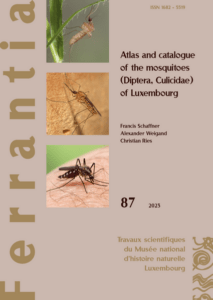 Schaffner F., A. Weigand & C. Ries, 2023. – Atlas and catalogue of the mosquitoes (Diptera, Culicidae) of Luxembourg. Ferrantia 87, Musée national d’histoire naturelle, Luxembourg, 117 p. [PDF 5.2 MB]
The Atlas of the Mosquitoes of Luxembourg has just been published in the Ferrantia series of the National Museum of Natural History and describes 28 species (31 taxa) of culicides found in the Grand Duchy.
Mosquito-borne diseases such as chikungunya, dengue, Usutu or West Nile, have come back to the forefront in both human and animal health. To prevent outbreaks, it is necessary to acquire a solid knowledge of the mosquito fauna in the considered area. Therefore, and since the mosquito fauna of Luxembourg was only partially known, we suggested the construction of the first comprehensive mosquito diversity and distribution database for the Grand Duchy as a base for an atlas. This atlas of the mosquitoes of Luxembourg assembles a taxonomic list and species distribution maps.
The Atlas was developed in the framework of the MosquitoLUX (2019-2022) project implemented under the auspices of the Fondation faune-flore at the Scientific Research Centre of the National Museum of Natural History in Luxembourg. The Fondation faune-flore was the host institution and administrative manager of the project.
Funding consortium :
• 50%: National Museum of Natural History, Departments of Ecology and Zoology
• 25%: Ministry of Environment, Climate and Sustainable Development
• 25%: Directorate of Health
Page content last updated on 2023-03-27. Last proofread by Caroline Grounds on 2023-03-27.
 The Ministry of Health informs that a population of the invasive Asian tiger mosquito Aedes albopictus has been detected at two locations in the territory of the Commune of Roeser. This first appearance of the tiger mosquito in the Grand Duchy has been confirmed by an international expert in the field. According to current information, this is a limited phenomenon. The tiger mosquito does not move very far and usually does not travel more than a hundred metres from its birthplace.
In the next few days, the Luxembourg authorities, with the support of an expert, will assess the situation, as well as set up a prevention plan and a surveillance and eradication system. The use of insecticides is currently under consideration. However, eradication would be mainly through the elimination of potential habitats.
Communicated on 2022-09-03 by the Ministry of Health: Première apparition du moustique tigre “Aedes albopictus” au Luxembourg
More information:
Page content last updated on 2026-06-16. Last proofread by Caroline Grounds on 2022-09-06.
The National Museum of Natural History published a series of posters in cooperation with the Ministry for the Environment and the Health Directorate.
These five posters are available in English and German on our Download page: https://mosquitoes.lu/resources/downloads/.
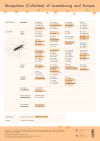
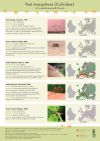
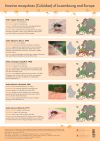
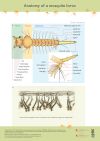
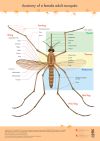
The posters cover the following topics:
Page content last updated on 2026-06-16.
Page content last updated on 2021-08-30.
“On 13 June 2019, in a sample of mosquitoes captured in the province of Flevoland, the Netherlands during routine surveillance, a specimen was recognised as potentially belonging to an exotic species. Based on the molecular analysis of the specimen, we concluded that it belonged to Aedes flavopictus (Yamada, 1921). To our knowledge, this is both the first time that this species has been reported outside its area of origin in north-east Asia and associated with the import of used tyres” (Ibáñez-Justicia et al. 2019).
References
Page content last updated on 2019-07-29.
In June 2019, during the second field work period for the MosquitoLUX project aiming to produce an atlas of the mosquitoes of Luxembourg, two species new to Luxembourg have been found: Culex modestus (an important vector for the West Nile Virus) and Uranotaenia unguiculata. Additionally, Culiseta glaphyroptera (Schiner, 1864), also a mosquito species new to Luxembourg, was found in the bycatches from 2007 from Dieter Weber in the Museum (Weber 2013). This extends the provisional checklist to 25 species.
Uranotaenia unguiculata Edwards, 1913
Schengen, Remerschen/Wintrange (1 pupa, 20/06/2019). Immature stages sampling in a large pond border among reeds and algae, with Anopheles claviger, Anopheles maculipennis s.l., Culex modestus, Culex pipiens, Culex territans, and Culiseta annulata.
Culex modestus Ficalbi, 1889
Schengen, Remerschen/Wintrange (13 larvae and 3 pupae, 20/06/2019; 2 females, 24/06/2019). Immature stages sampling in a large pond border among reeds and algae, with Anopheles claviger, Anopheles maculipennis s.l., Culex pipiens, Culex territans, Culiseta annulata, and Uranotaenia unguiculata; Adult trapping (CO2-baited trap) in a reed bed shaded border.
Literature
Page content last updated on 2020-03-03. Last proofread by Caroline Grounds on 2019-11-06.
Synonyms:
| Common names | Further info sources |
|---|---|
   n/a n/a  |
Wikipedia:     Wikispecies: n/a |
Advice for the population: Please refer to our special page on how to deal with mosquitoes.
Records of in Luxembourg. Data source: Recorder-Lux, iNaturalist & GBIF, 16.02.2023.
Page content last updated on 2019-04-26.
Synonyms:
| Common names | Further info sources |
|---|---|
| n/a |
Wikipedia: Wikispecies: n/a |
Advice for the population: Please refer to our special page on how to deal with mosquitoes.
Records of in Luxembourg. Data source: Recorder-Lux, iNaturalist & GBIF, 16.02.2023.
Page content last updated on 2019-04-26.